Core Math for ML, AI and Data Science

Gain a solid understanding of the mathematics driving Artificial Intelligence, Machine Learning, and Data Science
  • Project Based
  • ·
  • Book Centered
  • ·
  • 6 weeks
Picture of Thomas Nield
Thomas Nield
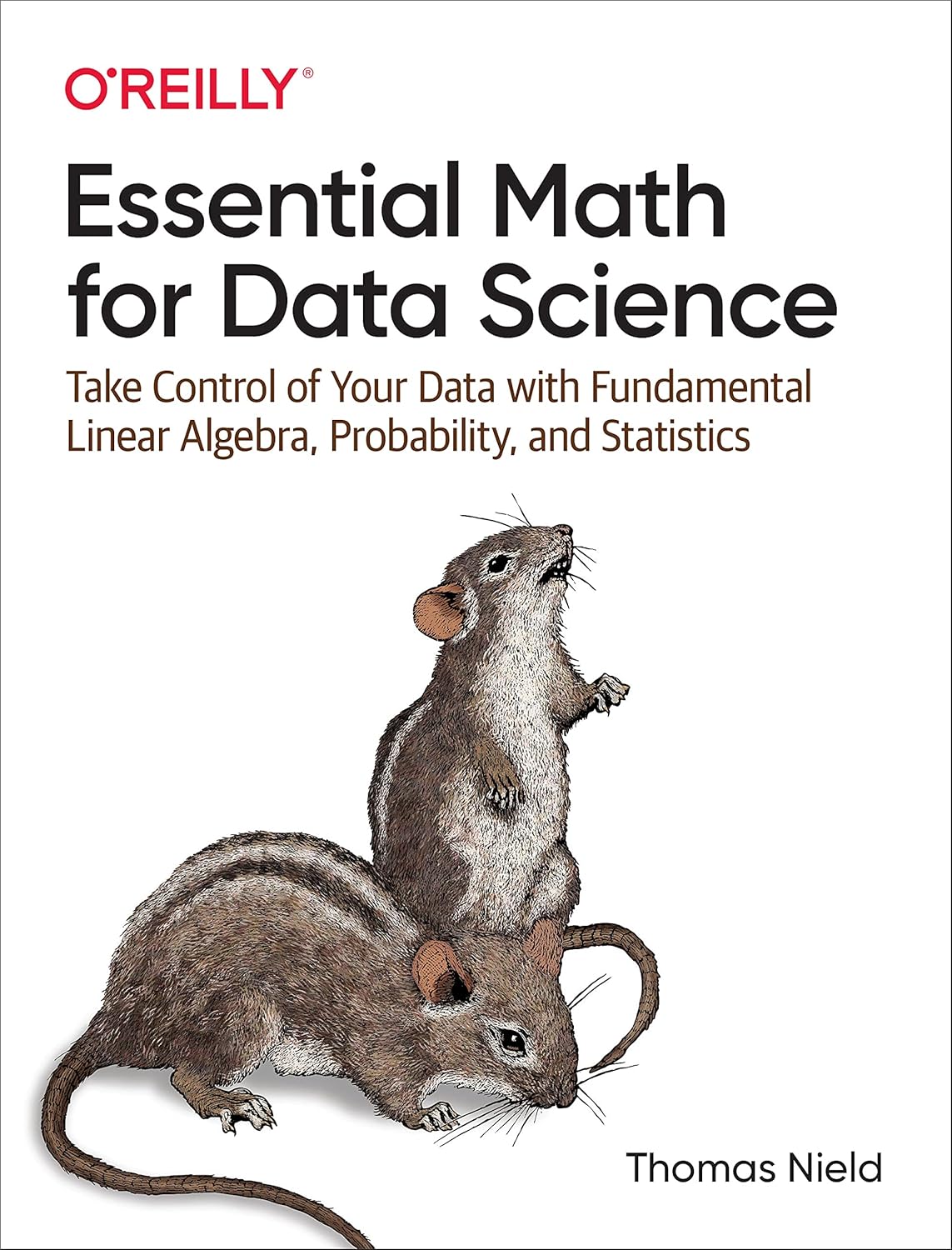
Author of Essential Math for Data Science
Learn directly from the author
  • 4.6 stars on Amazon
  • 4.2 stars on Goodreads
Cohort
Learn in a structured, classroom environment
No cohorts scheduled. Get notified at launch
or
Solo
Learn solo at your own pace
Trusted by students from
  • stanford.svg
  • usc.png
  • google.svg
  • nvidia.png
  • aaa.png
  • stanford.svg
  • usc.png
  • google.svg
  • nvidia.png
  • aaa.png
  • stanford.svg
  • usc.png
  • google.svg
  • nvidia.png
  • aaa.png
  • stanford.svg
  • usc.png
  • google.svg
  • nvidia.png
  • aaa.png
 
What you'll learn
  • Core math for Machine Learning, Artificial Intelligence and Data Science
  • Understand concepts of applied Linear Algebra, Calculus, Probability, Statistics and Regression Techniques
  • Gain autonomy to speak the strengths and weaknesses of different models being used by industries and research teams
Machine learning, artificial intelligence, and data science topics are hard to navigate without some essential mathematical concepts. So whether students are trying to pivot into these areas or looking to get started, they will ultimately need to grasp the applied math concepts presented in this course.
Picture of Thomas Nield
Thomas Nield
Instructors

Teaching Team

Picture of Thomas Nield
Thomas Nield
  • Author of Essential Math for Data Science (O'Reilly Media)
  • ·
  • Teach AI System Safety at USC
Thomas Nield is a consultant, writer, and instructor. After a decade in the airline industry, he authored two books for O’Reilly Media and regularly teaches classes on artificial intelligence, statistics, machine learning, and optimization algorithms. Currently he is teaching at University of Southern California and defining system safety approaches with AI for clients.
Syllabus

Course Outline

Week 0 - Kickoff
  • Understand what the course will cover
  • Understand what is expected of participants in this course
  • Understand how to get the most out of this course
  • Meet your instructor
Week 1 - Linear Algebra
  • Learn how to compose data as vectors and matrices
  • Use NumPy to work with linear transformations
  • Apply linear algebra to tasks like matrix decomposition and systems of equations
Week 2 - Calculus Basics
  • Leverage SymPy to declare and work with functions
  • Calculate derivatives to find slopes with respect to variables
  • Calculate integrals to find areas under a curve
Week 3 - Probability Basics
  • Create Monte Carlo simulations
  • Calculate joint and union probability
  • Leverage conditional probability and Bayes Theorem
Week 4 - Descriptive and Inferential Statistics
  • Describe data using parameters like the mean, median, variance, standard deviation, and coefficient of variation
  • Leverage the central limit theorem to infer population parameters from a sample
  • Perform confidence intervals and hypothesis testing to identify population parameters from a sample
Week 5 - Linear Regressions and Logistic Regression
  • Fit data to regressions models like linear regression and logistic regression
  • Evaluate the quality of a regression model and whether variance and overfitting are occurring
  • Learn techniques like matrix decomposition, gradient descent, and hill climbing to fit a regression
Week 6 - Model Validation
  • Understand the nature of data and how problems like bias, outliers, and operating domain affect success of a project
  • Leverage train/test split patterns to see how well models perform on data not seen before
  • Avoid fallacies like Texas Sharpshooter Fallacy and p-hacking which become prevalent with big data availability
Week 7 - Project Submission
    Project

    Measure and Apply Statistics in the Real World by Evaluating a Household Item and Its Functions

    About
    Apply the concepts in this class by gathering sample data about something measurable in your household. Start with a question, whether it is measuring the average battery life of your MacBook Air, identifying drift in your favorite gamepad, or questioning if your favorite packaged snack has a consistent weight as advertised. Follow a question that you can measure, gather data for, and apply descriptive statistics and confidence intervals. If you can perform hypothesis testing between competing products (e.g., which laptop has better or more consistent battery life) or changing a variable (e.g., does the laptop battery life worsen with certain apps open?), then that is even better.
    Audience

    Who's This Course For?

    Undergrad and graduate students majoring in Computer Science, Data Science, Machine Learning, and Artificial Intelligence

    Data analyts or software engineers aiming to advance or shift into AI/ML

    Basic algebra and computer skills required; Python optional - students can focus on the concepts instead
    Teaching Methods

    How You'll Learn

    Project-Based
    Learn from a concrete project with real-world constraints
    Solo
    Applied in
    • Cohort
    • Solo
    Book-Centered
    Course modules expands on Essential Math For Data Science chapters and require weekly readings from the book
    Applied in
    • Cohort
    • Solo
    Flipped Learning
    Students review the core materials independently during the week, then join a 1-hour live session with instructors and peers for active engagement
    Applied in
    • Cohort
    Testimonials

    What Our Students Have to Say

    Learning Dynamics

    Learn Your Way

    SoloCohort
    $149
    $749
    Dynamics

    Self-Paced

    Learn independently, on your own schedule

    Instructor-Paced

    Learn in a structured classroom environment, with peers and instructors
    Class Materials
    Lifetime Access
    LMS Features

    Basic

    Basic

    • Shared Resources
    • Comments
    • Reading Highlights
    • Assignment Solutions
    Live Sessions
    Physical Book & Materials
    Certificate
    $200 Completion Bonus
    Project Critique & Demo
    Access to Instructors
    Community Channels & Shared Resources
    Faq

    Frequently Asked Questions

    • Can my employer cover the program cost?
    • Can I get a full refund if I’m not satisfied? How do refunds work?
    • How are certificates issued?
    • Will this cohort run again?
    • Do I get lifetime access to course materials?
    • What does book-centered means?
    • What’s the difference between Cohort and Solo formats?
    Copyright @ 2026 Classpert. All rights reserved.